 Desk Notes
Five Vitamins Each Got a Number. Nine Plants Share One.
Magic Mind Original is a two-ounce morning bottle from Venice, California. I opened a ledger, gave every line on its panel a column, and wrote down what the studies used beside what the label gives.

This is a paid advertisement. Sponsored by 10,000 Inc.

Edgar Mowbray is the pen name of this desk.
Everything on this page about the bottle comes from the seller's own product page, its published label file, its terms and its public review system, all read on September 20, 2026.
The customers quoted further down are real and their words are public on the seller's own page.
The small pictures beside them are illustrations, not the reviewers.
I kept books for a living for thirty-one years, and the habit never left me.
When a man hands me something with figures printed on the back, my hands open a ledger before my head decides to.
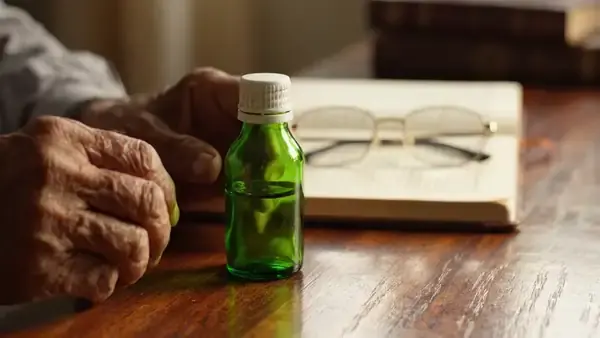
Last month a friend handed me a small green glass bottle across a counter, cold, the size of a hotel shampoo.
He wanted to know whether the back of it meant anything.
That is the only question worth asking about a label, and almost nobody asks it out loud.
So I did what I have done with every set of figures anyone ever put in front of me.
I ruled a page, wrote the bottle's numbers down the left, and left a second column empty for what the research actually used.
A ledger has one rule, and it is the whole trade: a line with no figure beside it is not a line.
It is a note in the margin, and a note in the margin never went into anybody's total.
By the time I closed the book, five lines on this panel had a figure in both columns, and one line had a figure in the left column that covered nine different things at once.
That is the short version, and the rest of this page is the working.
It takes a while, because the working is where the truth of a set of figures lives, and because half of what matters here is not printed at all.
Magic Mind Original is made and sold by a company registered as 10,000 Inc., with a street address on Electric Avenue in Venice, California.
It is a dietary supplement in the form of a drink, which is an unusual combination and matters more than it sounds.
It is perishable.
The seller says so plainly, tells you to keep the bottles cold, and for that reason does not take the product back.
Hold on to that, because it changes the whole shape of the refund terms at the end of this page, and the refund terms are one of the two best things about this purchase.
The Ledger, and the One Rule I Keep It By
Every panel on every bottle is a set of accounts.
It has line items, it has amounts, and it has a total, and the interesting part of any set of accounts is never the total.
It is the line that carries several things at once.
An accountant calls that a lumped entry, and the first thing anybody trained to read figures does is ask what is inside it.

So here is the method, and it is the only one I have ever trusted with a label.
Write down what the bottle gives you, in the unit the bottle uses.
Beside it, write down what the study that made that ingredient worth naming actually used, in the same unit.
Then look at the two columns and decide for yourself whether they belong on the same page.
That is all. No judgement of the company, no opinion about the plants, no verdict about whether it works.
Two columns, the same unit, and the difference between them.
The reason this method is worth your time is that it cannot be argued with.
A number either matches a study or it does not, and when there is no number at all, that fact is the finding.
The blank space in a set of accounts is information. It is usually the most expensive information on the page.
I will say the honest shape of it now, so nobody has to read eight thousand words to find out where this lands.
Five of the lines on this panel carry a figure, and they are the five lines whose best evidence in ordinary adults is the weakest on the page.
One line carries a figure that belongs to nine things at once, and those nine include every plant a man would buy this bottle for.
And one pairing on this bottle, the caffeine and one of the nine, has a study behind it at almost exactly the caffeine amount printed.
Of that pairing, the bottle prints one half and leaves the other half inside the lumped line. That single sentence is the whole page.
What the Panel Prints, Line by Line
Here is the panel, transcribed from the seller's own label file, for one bottle.
I have changed nothing and left nothing out.
Calories, twenty-five.
Total fat, one gram.
Total carbohydrate, four grams.
Total sugars, three grams, and the panel adds that all three are added sugars, six percent of the day.
Vitamin C, as ascorbic acid, one hundred milligrams, one hundred and eleven percent of the Daily Value.
Vitamin D3, twenty-five micrograms, which is a thousand international units, one hundred and twenty-five percent.
Riboflavin, which is vitamin B2, one milligram, seventy-seven percent.
Niacin, which is vitamin B3, eight milligrams, fifty percent.
Vitamin B12, two point four micrograms, one hundred percent of the day.
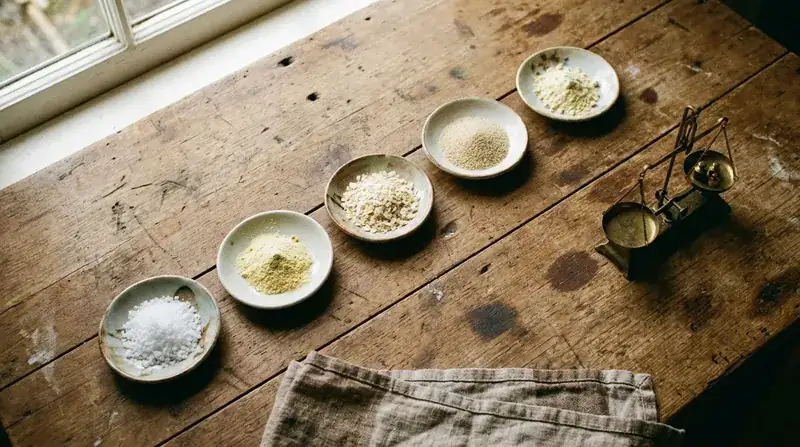
Those are the five vitamin lines, and every one of them has both a weight and a percentage beside it.
And then the last line.
A patented blend, one thousand nine hundred and twenty-five milligrams, with an asterisk where the percentage would go.
The seller's page names what is inside that blend: lion's mane, bacopa monnieri, citicoline, L-theanine, ceremonial-grade matcha, rhodiola rosea, cordyceps, ashwagandha and turmeric.
Nine names, one figure between them, and no split printed anywhere I could find.
One more number, which the seller gives on the product page rather than on the panel.
Fifty-five milligrams of caffeine a bottle, and the seller says it comes from the matcha.
Six entries with a figure, nine plants sharing a seventh, and one number that arrived from a different page.
The Five Lines With Numbers, and What Those Numbers Buy
Start where the figures are, because that is where a ledger always starts.
Five vitamins, five weights, five percentages, and every one of them out in the open.
The percentages are calculated against the Daily Values the Food and Drug Administration sets for adults, which is why the same milligram can read as fifty percent on one line and a hundred and eleven on another. [1]
That part of the panel is doing exactly what it is supposed to do.
Now the second column, and this is the part a man deserves to hear plainly before he pays.
In ordinary adults who are not short of these vitamins, the best evidence we have for B vitamins and everyday thinking is a null result.
A Cochrane review pooled fourteen randomized trials covering 27,882 adults with no cognitive problems and concluded that B-vitamin supplements probably have little or no effect on overall thinking scores at any point up to five years. [2]
That review covered folic acid, B12, B6 and combinations of them, and most of the people in it were over sixty.
The vitamin D line goes the same way.
In a three-year randomized trial of 2,157 adults aged seventy and over, two thousand international units of vitamin D3 a day, alone or combined with other things, produced no statistically significant benefit on a cognitive screening score. [3]
This bottle carries a thousand international units, half that amount, for a shorter time.
I am not telling you the vitamin lines are pointless; I am telling you that they are the only lines on the panel with real figures, and they are the lines with the least to show for themselves.
That inversion is the single most useful thing on this page, and it costs you nothing to remember: the numbered lines are the weak ones, and the strong ones are inside the line with no numbers.
There is one honest exception, and I will not skip it.
Vitamin B12 is the one nutrient on this panel where an older man genuinely might be short.
The National Institutes of Health's own fact sheet notes that, depending on the definition used, somewhere between three and forty-three percent of older adults living at home have low B12 in their blood, and that the stomach lining of many people over sixty-five absorbs less of it from food. [4]
The same sheet notes that the B12 added to supplements and fortified foods is already in the form the body can take up without that step.
So if nobody has looked at your B12 in a few years, ask.
That is a blood draw and a conversation with your own clinician, it costs a fraction of a box of these bottles, and it answers a real question instead of a marketed one.
A number you can act on is worth more than a number you can buy.
The Sixth Line, and Why It Is Not Like the Other Five
Now the line that brought me here.
One thousand nine hundred and twenty-five milligrams, described as a patented blend, with an asterisk in the column where a percentage would be.
A proprietary blend is a perfectly legal thing.
A company may print the total weight of a mixture and the names of what is in it, in order of how much there is, without printing the individual amounts.
The reason given is usually that the recipe is the company's own and a competitor could copy it.
That is a real commercial argument, and I am not going to pretend it is dishonest on its face.
But an argument for keeping a figure private is not the same as a figure.
From where you are standing, holding the bottle, a blend total tells you what the nine weigh together and nothing at all about any one of them.
And the nine names in this blend are, with one exception, the reason anybody picks this bottle up in the first place.
Here is what you do know from the order of the names, and it is worth something.
The seller lists them as lion's mane, bacopa, citicoline, L-theanine, matcha, rhodiola, cordyceps, ashwagandha and turmeric.
If that list follows the usual convention, the first name weighs the most and the last weighs the least.
But conventions are not figures, the ingredient list on the product page is not the panel, and I will not build a column out of an assumption.
So the left column of my ledger has one entry for all nine: 1,925 milligrams, shared, split unknown.

One Thousand Nine Hundred and Twenty-Five, Divided Nine Ways
An accountant faced with a lumped entry does one thing before anything else.
He divides it evenly, not because it is even, but to see what the best case for each part could possibly look like.
So: 1,925 divided by nine.
Two hundred and thirteen milligrams, and nine-tenths of another.
That is the average share if every one of those nine plants and compounds carried exactly the same weight.
Nothing says they do, and almost certainly they do not, but it is the only honest first pass a man can make with the figures he has been given.
Now hold two hundred and fourteen milligrams in your head, because the rest of this section is that number sitting beside the amounts the studies actually used.
I did them one at a time, in the order the seller lists them.
This is the second column of the ledger, and it is where the page stops being about a bottle and starts being about arithmetic.
Lion's Mane: the Study Used Three Thousand Two Hundred Milligrams
Lion's mane is the first name on the list, which by convention means it is the heaviest of the nine.
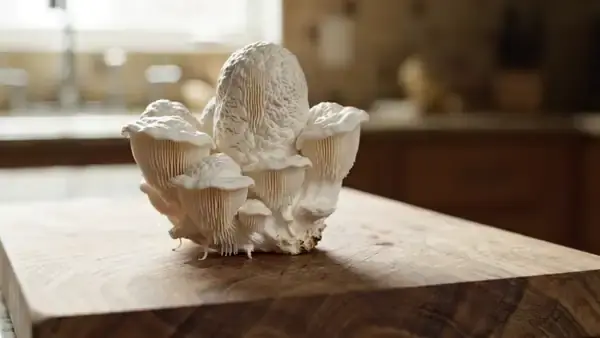
It is a shaggy white mushroom that grows on hardwood, eaten in Japan and China and now farmed widely in the United States.
The trial that made it worth naming on a bottle is small and specific.
Thirty-one healthy adults over fifty took a preparation of the mushroom's fruiting body every day for twelve weeks and scored higher on a standard mental-status test than the placebo group. [5]
The daily amount in that trial was three point two grams.
Three thousand two hundred milligrams, of the mushroom alone, and this entire blend weighs 1,925.
Read that twice, because it is the largest single gap on this page.
Even if the lion's mane were the only thing in the blend and the other eight names were printed for decoration, the bottle would still be carrying about six-tenths of the amount used in that trial.
At the even split of 214 milligrams, it carries about a fifteenth of it.
I am not able to tell you which of those two pictures is closer to the truth, and neither is anyone else outside the company.
There is a second study worth putting in the column, and it cuts the other way.
Forty-one healthy adults aged eighteen to forty-five took a single one point eight gram dose and performed faster on an attention task an hour later, while twenty-eight days of the same supplement produced only a non-significant trend on the other measure. [6]
One point eight grams is still 1,800 milligrams, nearly the weight of this whole blend, in people young enough to be your children.
That study is a pilot, its authors asked for caution, and I pass that caution straight on to you.
Lion's mane, left column: unknown, somewhere at or below 1,925 milligrams. Right column: 3,200 milligrams in the only trial run in adults your age.
Bacopa: Three Hundred Milligrams, Twelve Weeks, and a Note About Your Stomach
Bacopa monnieri is a small creeping marsh herb from India, used in Ayurvedic practice for a very long time.
It is the name on this list with the most consistent research behind it in people the age of the men who read this page.
Fifty-four healthy adults aged sixty-five and over took three hundred milligrams a day of a standardized extract for twelve weeks.
Forty-eight finished, and they recalled more words after a delay and did better on a task of ignoring irrelevant information than the placebo group, with no difference on divided attention or immediate working memory. [7]
A second trial in ninety-eight healthy adults over fifty-five, of whom eighty-one finished, used the same three hundred milligrams a day for the same twelve weeks.
Better verbal learning and delayed recall than placebo; other memory and attention measures no different. [8]
And a pooled analysis of nine randomized placebo-controlled trials, 518 people between them, all taking a standardized extract for at least twelve weeks, found faster performance on two measures of attention speed and concluded that the herb has potential, pending a large well-designed trial. [9]
Differences of milliseconds, and the authors asked for that larger trial themselves.
So the right-hand column here reads three hundred milligrams a day, for twelve weeks, of a standardized extract.
That is a real, specific, repeatable figure, and it is the one I most wanted to see printed on this bottle.
If bacopa took its even ninth of the blend, 214 milligrams, it would be at about seven-tenths of the studied amount, which is closer than anything else on this list.
But it is the second name of nine, the split is not printed, and the extract in those trials was standardized to a stated strength, which this panel does not state either.
One thing those trials do tell you that the bottle does not.
In both of them the commonest side effect was digestive: stomach upset in the first, more frequent stools, cramps and nausea in the second. [7] [8]
That is not a reason to avoid it. It is a reason to take the first bottles of anything with food, and to know what you are feeling if you feel it.
Citicoline: Five Hundred Milligrams for Twelve Weeks
Citicoline is not a plant.
It is a compound the body already makes and uses in building cell membranes, and it is sold as a supplement ingredient under more than one brand name.
Its best trial for a man your age is specific about the amount.
One hundred healthy adults aged fifty to eighty-five with age-associated memory complaints took five hundred milligrams a day for twelve weeks and improved more than placebo on a paired-associate memory test, while overall memory improved in both groups. [10]
Five hundred milligrams.
That single ingredient, at its studied amount, would be more than a quarter of this entire 1,925-milligram blend on its own.
There is a smaller trial at a lower amount, and it is fair to put it in the column too.
Sixty healthy women aged forty to sixty took two hundred and fifty milligrams a day for twenty-eight days and made fewer errors on a computerized attention task than placebo, with several of the authors affiliated with the ingredient's maker. [11]
Women only, attention rather than memory, a small open-access journal, and the manufacturer in the author list.
I put it in the ledger because it exists and because 250 milligrams is a figure a blend of this size could plausibly reach, and I mark it exactly as weak as it is.
Citicoline, right column: 500 milligrams in adults your age, or 250 in a smaller study of women half your age. Left column: unknown.
Turmeric: Ninety Milligrams, Twice a Day, for Eighteen Months
Turmeric is the yellow root in the spice drawer, and the compound researchers care about in it is curcumin.
The trial people point to is longer than anything else on this list.
Forty adults aged fifty-one to eighty-four took a highly bioavailable form of curcumin, ninety milligrams twice a day, for eighteen months, and scored better on verbal memory, visual memory and attention than the placebo group. [12]
Forty people, twenty-one against nineteen, and a patented high-absorption formulation rather than the spice.
One hundred and eighty milligrams of curcumin a day, for a year and a half.
Note the form: that trial did not use turmeric root powder, and the difference between the root and a high-absorption curcumin preparation is the entire reason the trial was designed the way it was.
This panel says turmeric, eighth of nine names, amount not printed, form not printed.
The National Institutes of Health's center for complementary health states that we do not know enough to conclude whether turmeric or curcumin is beneficial for any health purpose. [13]
That is the government's own summary of the whole field, and it is more cautious than any advertisement you will ever read, including ours.
I put it in the ledger word for word because you are entitled to the same sentence the researchers get.

Ashwagandha, Rhodiola and Cordyceps: Two Studies and One Blank
Three names left before the two that matter most, and I will take them together because the ledger gives all three the same short column.
Each is a real plant with a real tradition and a thin file of research in men your age.
Ashwagandha first.
Fifty-nine healthy young adults, average age twenty-three, took a single two hundred and twenty-five milligram dose of a liposomal root-and-leaf extract, and then thirty days of the same amount daily, and did better than placebo on some measures of word recall, reaction time and picture recognition. [14]
Average age twenty-three.
That is a study about undergraduates, in a specific liposomal form, and I will not lend it to a man of sixty-seven who is standing at a counter deciding whether to spend seventy-five dollars.
Rhodiola next, and its file is older and stranger.
Fifty-six healthy young physicians on night duty took one tablet a day of a standardized extract in a crossover study and did better on tests of mental tiredness during the first two-week period, and the report lists nothing adverse. [15]
Night shifts, young adults, and an amount in milligrams that the published summary does not state.
When the study itself will not give me a figure, the right column stays empty, and an empty right column is a finding.
Cordyceps last, and it is the plainest entry in the book.
I could not find a trial of cordyceps on memory or attention in healthy adults to put in the column, and I am not going to borrow one from a different kind of study.
Three names, one study in twenty-three-year-olds, one study in young physicians with no amount printed, and one blank. That is the honest state of those three lines.
A blank in a ledger is not a scandal. It is a blank, and it stays a blank until somebody fills it.
The Matcha Is Not Just Another Name on the List
Here is the piece of arithmetic that made me stop and refill my pen.
Matcha is on the list of nine, fifth by order, and the seller says the fifty-five milligrams of caffeine in the bottle comes from it.
Matcha is powdered green tea leaf.
Green, black and oolong tea all come from the same plant, and green tea contains caffeine, which is the whole reason it is in a morning bottle. [16]
Now follow it through.
To deliver fifty-five milligrams of caffeine, the bottle has to contain enough matcha powder to carry fifty-five milligrams of caffeine, and every gram of that powder comes out of the same 1,925 milligrams.
I cannot tell you how many milligrams of matcha that is, because I could not find a figure for the caffeine in a gram of ceremonial-grade powder that I would be willing to hand you as fact.
What I can tell you is the direction, and the direction is the point.
Whatever weight the matcha takes, the other eight names divide what is left over, and it is less than 1,925.
The even ninth of 214 milligrams was already the optimistic reading; once the matcha takes a real and unstated share, the optimism has to come down.
That is not an accusation.
It is subtraction, and subtraction is the only thing I have ever been good at.

The matcha is also the reason the bottle is green, so this is a fair moment to set the bottle itself on the desk and look at it whole.
Fifty-Five Milligrams, and the One Pairing on This Bottle With a Study Behind It
And now the line I would underline if a man gave me this label and one pencil.
Fifty-five milligrams of caffeine, printed, from the matcha.
Caffeine is the most studied thing in this bottle by a distance, and it is also the only ingredient here that you already know the feel of.
The Food and Drug Administration cites four hundred milligrams a day, about two to three twelve-ounce cups of brewed coffee, as an amount not generally associated with negative effects in most healthy adults. [17]
The European Food Safety Authority reached a similar place from the other direction, concluding that single doses up to two hundred milligrams and daily intakes up to four hundred do not raise safety concerns for healthy adults, and that caffeine in moderate amounts increases alertness. [18]
Fifty-five milligrams sits a long way inside both of those, which is the point of the Original version: it is the small one.
Here is what makes this line different from every other line on the panel.
There is a published crossover study of twenty-seven healthy volunteers in which fifty milligrams of caffeine taken together with one hundred milligrams of L-theanine produced faster and more accurate performance on an attention-switching task an hour later, and less susceptibility to distracting information in a memory task at sixty and ninety minutes. [19]
Fifty milligrams of caffeine.
This bottle prints fifty-five, which is as close as a real product ever gets to the number in a study.
L-theanine is the fourth name in the blend.
It is an amino acid found in tea leaf, and it is the other half of the only pairing on this entire bottle that has a trial standing behind it at the amount printed.
And the bottle prints one half of that pairing and puts the other half inside the line with no figures.
That is the sentence I would have written on the ledger and shown to my friend across the counter, and it is why this page exists.
One hundred milligrams of theanine would be about half of the even ninth I calculated earlier, so it is not a wild amount for a blend of this size to contain.
It is also not printed, and not printed is not the same as present.
A single study of twenty-seven people, with a seven-day washout, whose authors worked for a tea manufacturer, is a thin reed to lean a purchase on even when you know both numbers. [19]
There is one more theanine study I will give you, and its own limits are instructive.
Japanese men and women aged fifty to sixty-nine with normal mental-status scores took a single dose of L-theanine and reacted faster on an attention task and answered more correctly on a working-memory task, but the published summary states neither the amount in milligrams nor the number of people, and the authors were from a tea company. [20]
No amount, no headcount, single dose, company authors.
I enter it in the ledger because it is real, and I mark it as thin, because it is.
This is the closest this bottle comes to a matched figure, and it is a half-match: one number printed, one number withheld, one study of twenty-seven people behind both of them.

Twenty-Five Calories, Three Grams of Sugar, and a Bottle That Lives in the Fridge
Two smaller entries before I total the page, because they belong in any honest set of accounts.
The first is the sugar.
Three grams of total sugars a bottle, and the panel states that all three are added sugars, six percent of the day.
That is a small amount in absolute terms, about three-quarters of a teaspoon, and it is there because the drink would otherwise taste of pressed grass.
It is worth knowing for one reason only.
If you are the kind of man who reads sugar figures on everything, this is one more small daily entry in that column, fifteen of them to a box.
The second is the cold.
This is a perishable drink, the seller tells you to keep the bottles refrigerated, and that is not a marketing flourish; it is a condition of the product.
It has one practical consequence you should think about before you order.
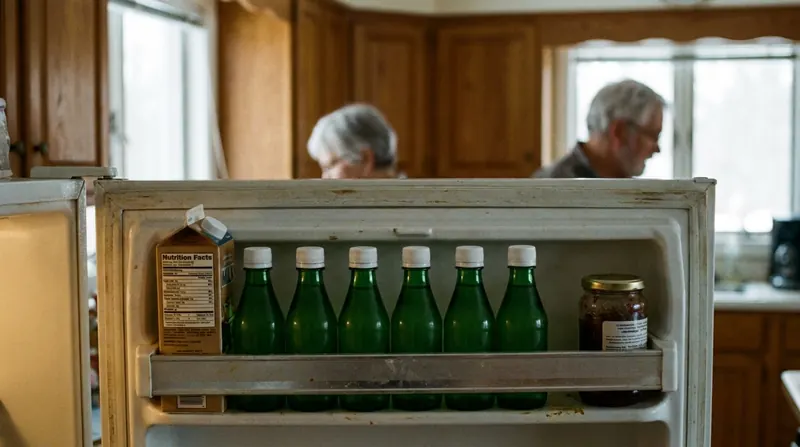
Fifteen bottles take up a shelf in your refrigerator door for two weeks, and if you travel or your fridge is already full, the box is inconvenient in a way a bottle of capsules never is.
Twenty-five calories, a gram of fat, four grams of carbohydrate.
As a food entry it is nothing at all, and I mention it only to be complete.
The Ledger, Totted Up
Here is the page as I closed it, both columns, in the order the panel prints them.
Left column is what the bottle gives; right column is what the research used.
Vitamin C, 100 milligrams, 111 percent of the day.
Right column: no trial of vitamin C and everyday thinking in ordinary adults that I would put in front of you.
Vitamin D3, 25 micrograms, 125 percent.
Right column: twice that amount for three years in 2,157 adults over seventy, no significant benefit on a cognitive screen. [3]
Riboflavin 1 milligram, niacin 8 milligrams, B12 2.4 micrograms.
Right column: a Cochrane review of fourteen trials in 27,882 adults with no cognitive problems, little or no effect up to five years. [2]
B12 has the one real asterisk in its favor, and it is not about this bottle.
Low B12 is genuinely common after sixty-five, and it is a blood test, not a purchase. [4]
Patented blend, 1,925 milligrams, nine names, no split.
Right column, name by name: lion's mane 3,200 milligrams; [5] bacopa 300 milligrams; [7] [8] citicoline 500 milligrams; [10] turmeric 180 milligrams of a high-absorption curcumin for eighteen months; [12] ashwagandha 225 milligrams in twenty-three-year-olds; [14] rhodiola, amount not stated; [15] cordyceps, blank.
Caffeine, 55 milligrams, from the matcha.
Right column: 50 milligrams paired with 100 milligrams of theanine in twenty-seven volunteers. [19]
Add the right column up and you get 4,405 milligrams of named ingredients at their studied amounts, before the theanine and the matcha, against a blend that weighs 1,925.
I want to be careful with that total, because a careless man could wave it about as if it proved something it does not.
Nobody has ever tested those nine things together, at any amounts, in anybody, and a mixture is not the sum of its parts.
What the total does show is the shape of the thing.
The studied amounts of just four of the nine names would overflow the whole blend twice over, so whatever is inside it, most of those nine cannot be at the amounts their own research used.
That is not an opinion about the company. It is what 1,925 milligrams means when nine names have to fit inside it.

What Two Hundred and Seventy-Four People Wrote
The seller's page carries a public review system with 274 reviews on it.
I read the ten most recent, which is what the widget gave me, and I am telling you that limit rather than implying I read all 274.
Of those ten, six carried five stars, one carried three, one carried two and two carried one, and every one of them was marked as a confirmed purchase.
That mix is worth more to me than any average, because it tells you the page is not filtering out the unhappy.
Then I threw most of them out, and you are owed the reason.
Which reviews a page chooses to show you is the whole game, and a man who does not tell you his rule is hiding it.
I threw out the ones that used the vocabulary of the category rather than the writer's own words.
I threw out one about a shipping problem, which is about a courier and not a bottle, and three with a rating and nothing written.
I threw out one that talked about payments to promoters without context, because I could not check it.
That left four, and I kept every one of them, including a two-star review, on purpose.
A man who paid for fifteen bottles and got nothing out of them has earned exactly as much space on this page as a man who paid and liked it.
Here they are, word for word, from the seller's own review system.

I am amazed. Best product on the market for energy.

Quick, easy start to my day. This works!

Love the results! But it tastes pretty bad…

With all the hype, I thought this would hit harder. For me, it was no more than a half cup of coffee or green tea. Just being honest—didn't live up to it.
Read them the way I did, one entry at a time.
Andrew says energy, which is the word most people reach for and the one the caffeine line would predict.
Ruth says quick and easy, which describes a habit that fits into a morning rather than an effect.
Julie says she likes the results and that it tastes bad, and the second half of her sentence is the more useful half.
And Bill, at two stars, says it was no more than a half cup of coffee or green tea.
I want you to notice what Bill has accidentally done, because it is better arithmetic than most of the reviews on any page.
The bottle contains fifty-five milligrams of caffeine, from powdered green tea.
Bill compared it to half a cup of coffee, and half a cup of coffee is roughly where fifty-five milligrams of caffeine lands.
The two-star review is the only one of the four whose description matches the panel. That is not a criticism of the bottle; it is a compliment to Bill.
One word about the number 274 itself, and then I will leave the reviews alone.
An average of 274 opinions measures how satisfied 274 people were with a purchase, which is a real thing, and a completely different thing from whether nine plants at unstated amounts did anything.

A Hundred Days, Once, and What That Sentence Actually Contains
Now the terms, which are the second best thing about this purchase and the part most pages skate over.
The seller offers a refund on a first purchase within one hundred days, and says it will refund the money with no need to ship anything back.
Read that twice, because both halves are unusual.
One hundred days is more than three months, and a first box of fifteen lasts about two weeks, so you would be deciding with eighty-five days still on the clock.
And no return shipment is genuinely generous for a buyer.
It is also a straightforward consequence of the product: the drink is perishable, the company says plainly that it does not accept returns, and a bottle that has sat in a courier's van for four days is of no use to anybody.
So the terms are what they are for a practical reason rather than a charitable one, and they are still the right terms.
The one thing you must hold on to is the word first.
The refund applies to a first purchase. It is not a standing arrangement that follows every box you ever order, and a subscription refill already shipped is a different matter.
That is not unusual, and the seller prints it plainly. It is simply the kind of clause a man remembers wrongly three months later.
If you are going to test this, test it on the first box, decide inside the window, and write the date on the calendar the day it arrives.
Two smaller things I found in the company's own papers, which I note because a ledger notes everything.
The address on the store's footer and contact page is on Electric Avenue in Venice, California, and the address printed in its privacy policy is a different one in San Francisco.
And the email address in the footer and on the contact page ends in dot com, while the returns policy writes the same address ending in dot co.
Neither of those is sinister, both are the sort of thing that happens when pages are written at different times by different hands, and both are worth knowing before you need to write to somebody about money.
If you ever have to start a refund, use the address on the contact page, keep the order number, and put the date you first wrote in your own notes.
The Cheaper Lines I Would Enter First
There is a conversation I have with every man who asks me about a bottle, and it comes before the bottle.
None of it is for sale, by me or by anyone, and all of it is cheaper than a box of fifteen.
Water first.
In a Berlin study of 1,111 adults aged sixty to eighty-nine, the third of them who were measurably short of water did worse over time on a processing-speed test than the rest, independent of their circumstances and their physical health. [21]
A later review of eighteen studies covering 33,707 adults aged sixty and over reached the same place more cautiously: the evidence linking being short of water to poorer performance on thinking tests is there, but it is sparse. [22]
Both are observational, neither proves cause, and a glass of water costs nothing and has no interactions to check.
The hour of the day next, and this one costs nothing at all.
If you are trying a morning bottle with fifty-five milligrams of caffeine in it, take it at the same hour every day, and compare your mornings with your mornings rather than your morning with last Tuesday afternoon.
Most men who think a supplement did something are comparing a good hour against an average one.
A fixed hour removes that, and it is the only piece of study design a man can run in his own kitchen.

Then your hearing and your eyesight.
Straining to catch what somebody said and then not being able to repeat it back looks exactly like not remembering it, from the inside and from the outside.
Getting both checked is an appointment, not a purchase, and it is the single most useful hour on this list.
Nobody makes any money from you making that call, which is roughly why you will not see it in an advertisement.
The pattern of what you eat, over years rather than weeks.
In a Brazilian study of 10,775 adults followed for about eight years, the people who ate the most from the ultra-processed shelf slipped somewhat faster on tests of thinking and planning than those who ate the least. [23]
And in a three-year randomized trial of 604 older adults, a group eating a Mediterranean-style pattern and a group simply eating a little less both improved their thinking scores, with no significant difference between them. [24]
Vegetables, beans, nuts, whole grains, olive oil, fish and berries are ordinary groceries, and they are untroubled by anything on this page.
Last, the one blood test on this page.
Ask your own clinician whether anybody has looked at your B12 in the last few years, because low B12 is common after sixty-five and a supplement is a poor substitute for knowing the number. [4]
Every line in this section is cheaper than a box of fifteen, and not one of them is sold by anybody.
Who Sells It, and What That Tells You
The bottle is sold by 10,000 Inc., trading as Magic Mind, from Venice, California, and that is the only place this page will send you.
The company publishes a street address, a telephone number that is answered between nine and five Pacific time, and an email address.
Those are facts about who you would be dealing with, and I keep them in a different column from facts about the plants, every single time.
A company can publish its address, answer its telephone and give you a hundred days, and still print 1,925 milligrams across nine names without a split.
This one does both, and the two facts do not cancel each other out.
Judge the terms on the terms, and judge the panel on the panel.
The bottles are also sold on other channels and in some physical stores, and the company runs its own subscription.
This page prints no price, because the seller sets it, it changes, and a welcome offer on a first box is not the price of the second one.
Look at the price on the day you look, and look at whether you are buying a box or starting a standing order, because those are not the same purchase.
Every line printed on the panel of this bottle, in plain English, with the amount the label gives and the study behind each name, is written out in full in the ingredient guide linked at the foot of this page.
That guide also carries the cautions, the references in full, and the disclosures this page is required to make.
The fifteen-bottle box, from the company on Electric Avenue
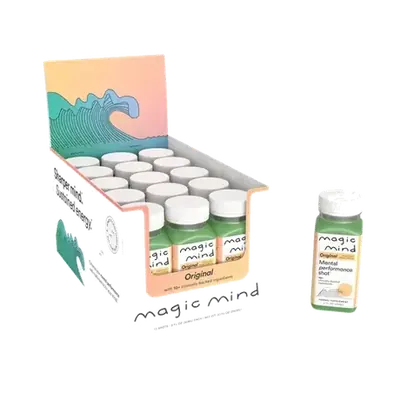
A small daily bottle of matcha, vitamins and a proprietary blend from a Venice, California company, with about half a cup of coffee's worth of caffeine.
VIEW THE BOX AND ITS PANELSold by 10,000 Inc., Venice, California · 15 two-ounce bottles, one a morning · 55 mg of caffeine a bottle · keep refrigerated · refund on a first purchase inside 100 days, nothing to ship back
The eight questions I get about this bottle
Is this medicine?
No. It is a dietary supplement sold as a drink, made and sold by 10,000 Inc. of Venice, California, and it is not meant for any medical condition.
How long does a box last?
Fifteen bottles, one a morning, is a fortnight and a day. The larger boxes are thirty and sixty bottles.
Which line on the panel has the best support?
The caffeine, at 55 milligrams. A study of twenty-seven volunteers used 50 milligrams of caffeine with 100 milligrams of L-theanine and found faster attention switching an hour later. [19] The theanine amount in this bottle is not printed.
Why does the label not say how much lion's mane there is?
Because it is inside a proprietary blend, which the law allows a company to print as one total. The line reads 1,925 milligrams for all nine names together.
How much caffeine is that, really?
About half a cup of brewed coffee. The Food and Drug Administration cites 400 milligrams a day as an amount not generally associated with negative effects in most healthy adults. [17]
Should I ask anyone before I start it?
Yes, if you take anything daily. Take the bottle to your pharmacist and ask, and ask your own clinician about a B12 level while you are at it. [4]
What if I do not like it?
You have one hundred days on a first purchase and nothing to ship back. Write to hello@magicmind.com or call (213) 568-6315 between nine and five Pacific time.
Are the reviews real?
Yes, and the seller's page carries 274 of them. I read the ten most recent and quote four, including one at two stars.
The Whole Ledger on One Page
- A two-ounce glass bottle of a perishable drink, fifteen to a box, one a morning, kept cold, made and sold by 10,000 Inc. of Venice, California.
- Five vitamin lines with a weight and a percentage each: C 100 mg, D3 25 mcg, B2 1 mg, B3 8 mg, B12 2.4 mcg, against the Daily Values the FDA sets. [1]
- The best evidence for B vitamins in adults with no cognitive problems is a Cochrane review of fourteen trials in 27,882 people finding little or no effect up to five years. [2]
- Vitamin D3 at twice this amount for three years in 2,157 adults over seventy produced no significant benefit on a cognitive screen. [3]
- One more line: a patented blend of 1,925 milligrams covering nine named plants and compounds, with no split printed for any of them.
- Divided evenly that is 213.9 milligrams each, against lion's mane at 3,200 in its trial, [5] bacopa at 300, [7] [8] [9] citicoline at 500 [10] and curcumin at 180 a day for eighteen months. [12]
- The matcha has to carry the bottle's 55 milligrams of caffeine, so it takes a real and unprinted share of the same 1,925 milligrams. [16]
- Rhodiola's study states no amount in milligrams, [15] the ashwagandha study was run in adults averaging twenty-three years old, [14] and I found no cordyceps trial in healthy adults to cite.
- Caffeine, 55 milligrams, is the only printed figure on this bottle that sits beside a study at almost the same number, and the other half of that pairing is unprinted. [19]
- Twenty-five calories, one gram of fat, four grams of carbohydrate and three grams of added sugar a bottle.
- Refund on a first purchase inside one hundred days with nothing to ship back; the product is perishable and the seller does not take it back; two addresses and two spellings of the email appear across the company's own pages.
- 274 reviews on the seller's page; I read the ten most recent and quote four, including one at two stars whose description matches the panel exactly.
- Before any of it: water, [21] [22] a fixed hour, your hearing, the pattern of what you eat [23] [24] and a B12 level. [4]
What Fifteen Mornings Are Actually Worth
Here is the whole thing in one breath, the way I would say it across a counter.
This is a well-made little drink with five honest vitamin lines whose research in ordinary adults comes up empty, half a cup of coffee's worth of caffeine, three-quarters of a teaspoon of sugar, and nine good names sharing one number.
Of those nine, one has a study at an amount fifteen times the average share available to it.
Two have studies at amounts a blend this size could plausibly reach, and neither is printed.
One was studied in people young enough to be your grandchildren, one was studied in an amount nobody published, and one has nothing at all.
And the single tightest match on the whole panel is the caffeine, which is also the one ingredient you could buy for eleven cents in a cup.
So who is this for.
If you want a cold, small, pleasant morning ritual with a modest amount of caffeine in it, and you want it in a bottle rather than a cup, this is an honest version of that thing, and the terms behind it are among the best I have read.
If you are buying it for the nine names, understand exactly what you are buying: a sealed total, an unstated split, and the company's word that the proportions are right.
That is a matter of trust rather than arithmetic, and a ledger cannot help you with trust.
Buy one box of fifteen rather than a subscription, and take it at the same hour every morning. Write one line a day for a fortnight, then decide with eighty-five days still on the clock.
That is the fairest test anybody can run on this bottle, and it is the one I told my friend to run.
He is nine days into it, he says it tastes of grass, and he has not made up his mind.
Which, after everything above, is exactly the right place to be on day nine.
One box of fifteen, and one hundred days to think about it
A small daily bottle of matcha, vitamins and a proprietary blend from a Venice, California company, with about half a cup of coffee's worth of caffeine.
VIEW THE BOX AND ITS PANEL10,000 Inc., 1291 Electric Ave, Venice, California · (213) 568-6315, nine to five Pacific · refund on a first purchase inside 100 days, nothing to ship back · keep the bottles cold
P.S. If you take two numbers from this page, take these.
One thousand nine hundred and twenty-five milligrams, shared by nine names with no split printed.
Fifty-five milligrams of caffeine, the only figure on the bottle that stands beside a study at nearly the same number.
P.P.S. If your worry about your own memory has been with you for a year, and it is there before the coffee as well as after it, speak to your own clinician before you buy anything at all.
A small cold bottle was never going to answer a question that a proper appointment and a blood test answer in an afternoon.